

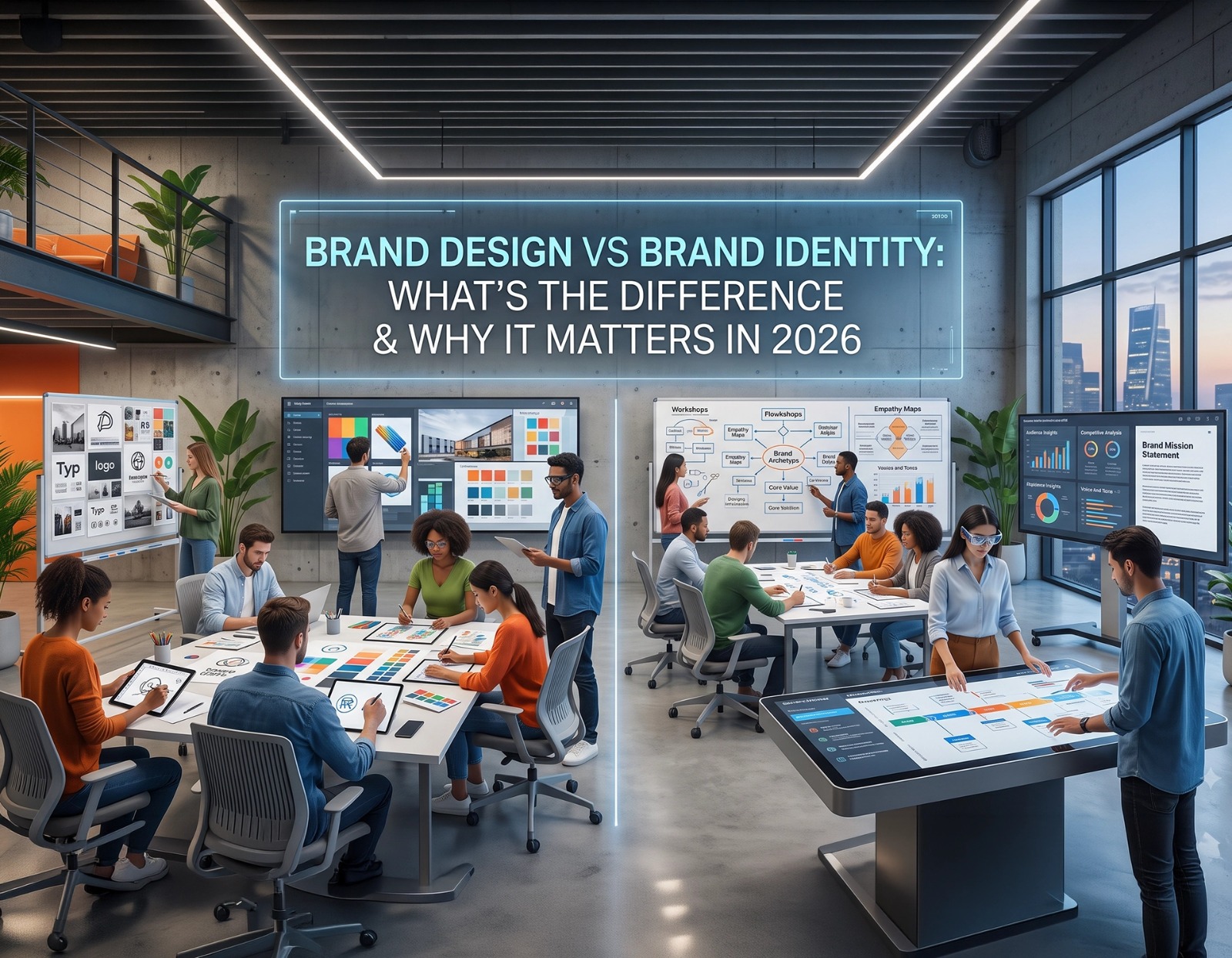
In 2026, building a brand is no longer just about looking good; it’s about being remembered, recognized, and trusted in a crowded digital-first world. Businesses today are constantly investing in branding, but one common confusion still holds many back: Brand Design vs Brand Identity. While these terms are often used interchangeably, they serve very different purposes and understanding that difference can define how your brand performs in the market.
As businesses navigate evolving consumer behavior, AI-driven marketing, and hyper-personalized experiences, understanding the difference between brand design and brand identity is no longer optional; it’s strategic. In this blog, we break down what sets them apart, how they work together, and why getting both right is essential for building a brand that stands out in 2026 and beyond.
What is Brand Identity and What is Brand Design?
To truly understand branding, you need to start at the foundation.
When we talk about what is brand identity, we are referring to the core essence of your business. It’s the personality of your brand, the way you communicate, your values, your tone, and how you position yourself in the minds of your audience. Brand identity is what shapes perception. It answers the deeper question: Why does your brand exist, and what does it stand for?
In contrast, brand design is the visual layer built on top of that identity. It’s the outward expression, the logos, colors, typography, website layouts, and everything that makes your brand visually recognizable. For businesses exploring brand design for startups India, this is often the first visible step in branding, but it is not the starting point.
The simplest way to put it is this: brand identity is the idea, while brand design is how that idea is visually communicated.
The Difference in Brand Identity & Brand Design
Understanding what the difference between brand design and brand identity in India is is crucial for any business aiming to build a lasting presence.
| Aspect | Brand Identity | Brand Design |
|---|---|---|
| Definition | Overall personality and perception | Visual representation of the brand |
| Scope | Strategic + emotional + visual | Mainly visual |
| Includes | Values, voice, positioning, messaging | Logo, colors, typography, graphics |
| Purpose | Builds recognition and trust | Creates visual appeal and recall |
| Example | “Innovative, youthful, premium” | Bold colors, modern fonts, sleek logo |
Here’s the simplest way to understand:
- Brand Identity = Strategy + Emotion
- Brand Design = Visual + Appearance
When comparing logo design vs branding in India, remember:
- Branding is the full experience
- Design is only the visual part
So, if you’re thinking about brand identity vs logo design for Indian SME, the priority should always be identity first.
Why Brand Identity & Brand Design Matter in 2026
In 2026, the importance of branding has only intensified. Consumers today are more aware, more selective, and more influenced by how a brand makes them feel.
This is exactly why many entrepreneurs are asking, why is brand identity important for startups in 2026?
The answer lies in differentiation. In a crowded digital space, where multiple brands offer similar products or services, identity becomes your edge. It’s what makes people choose you over others, even when the offerings are similar.
Brand design, meanwhile, plays a critical role in grabbing attention. First impressions are often visual, and in a scroll-driven world, your design is what makes someone pause. But without a strong identity backing it, that attention doesn’t convert into trust.
For businesses focusing on brand consistency, aligning identity and design ensures that every touchpoint, whether it’s a website, social media post, or packaging feels unified and intentional.
Elements That Shape Brand Identity and Brand Design
A brand identity is built over time, shaped by how consistently a business communicates its purpose and values. It includes elements like brand voice, messaging, positioning, and customer experience. These are not always visible, but they are always felt.
Brand design, in contrast, consists of tangible elements such as logo design, typography, color palette, imagery, and layout systems. These are the aspects people directly interact with and remember visually.
This distinction becomes important when discussing brand design vs brand identity. Branding is a complete experience, while design is just one part of it, although it is a very important one.
How Brand Identity & Design Differentiate You from Competitors
Let’s be honest, most industries today are crowded. Products are similar; pricing is competitive, and services overlap.
So, what makes you stand out? Your brand.
A well-defined identity combined with consistent design:
- Creates a unique positioning
- Makes your brand instantly recognizable
- Builds trust faster than competitors
- Reduces decision fatigue for customers
For example, when someone sees consistent colors, tone, and messaging across platforms, it builds brand consistency in India, which directly impacts recall and loyalty.
In fact, consistency alone can increase revenue by up to 20% because familiarity builds trust.
Can You Change Brand Identity or Brand Design?
The short answer is yes, but the approach matters.
Brand design is relatively easier to evolve. Many companies refresh their visual identity over time to stay relevant or modern. However, changing brand identity is a deeper process. It involves redefining your purpose, messaging, and positioning.
For businesses undergoing transformation or expansion, revisiting identity can be necessary. But it should always be done with clarity and intention, not just because trends are changing.
Five Key Differences Between Brand Design & Brand Identity
In today’s competitive market, especially in India’s fast-growing digital landscape, brands are often judged within seconds. While brand design and brand identity are frequently used interchangeably, they serve very different purposes. Understanding this distinction can shape how a business is perceived, remembered, and trusted.
A quick breakdown to simplify the difference:
Purpose
Brand Identity defines who you are as a brand.
Brand Design expresses how your brand appears to the world.
Nature
Brand Identity is strategic, rooted in emotion and positioning.
Brand Design is creative, focused on visual execution.
Scope
Brand Identity is the bigger picture.
Brand Design is a part of that larger identity system.
Focus
Brand Identity shapes how your audience perceives you.
Brand Design shapes what your audience sees and experiences.
Longevity
Brand Identity is a long-term foundation.
Brand Design evolves more frequently with trends and updates.
This clarity is essential when answering: what is the difference between brand design and brand identity in India?
How Brand Design & Brand Identity Work Together
Branding is most effective when identity and design work in harmony.
A strong identity gives direction to design, ensuring that visuals are not just appealing but meaningful. At the same time, effective design brings identity to life, making it tangible and relatable.
Without identity, design lacks depth. Without design, identity lacks visibility.
This synergy is what creates powerful brands; brands that not only look good but also feel authentic.
Using Brand Design and Brand Identity for Businesses
Understanding the difference between brand design and brand identity helps businesses build with intention, not just appearance. It’s about aligning how a brand looks with what it truly stands for.
For startups, the focus should be on getting the basics right. Instead of overcomplicating design, building a clear identity, who the brand is, who it serves, and how it communicates creates a stronger foundation. Consistent visuals then support and reinforce that identity across platforms.
For SMEs, growth brings the need to refine and upgrade. A more modern visual presence, combined with consistent communication, helps build credibility. At this stage, storytelling becomes a key differentiator, allowing brands to connect more deeply with their audience.
For large businesses, the challenge lies in maintaining consistency while scaling. Strong brand guidelines ensure that even as the business evolves, the core identity remains intact. Design can adapt, but the essence of the brand should stay steady.
In the end, businesses that align their identity with thoughtful design are the ones that create lasting impressions and meaningful connections.
Common Misconceptions Around Brand Design and Brand Identity
A common misunderstanding is treating a logo as the entire brand. While a logo is an important visual element, it represents only a small part of what truly defines a brand.
Another misconception is that a good design alone can build a strong brand. Without a clear identity; purpose, values, and positioning design lacks direction and fails to create meaningful connections.
Many also assume that branding is only for large or established companies. In reality, businesses of all sizes need a well-defined brand to stand out, especially in a crowded and competitive market.
Recognizing these misconceptions allows businesses to approach branding with more clarity, strategy, and long-term vision.
How GM Infotech Can Help Build Your Brand
Think about this for a second. When someone comes across your business, do they instantly get what you stand for, or do they just see another name with a logo? That gap is exactly where most brands struggle, often caught in the confusion of brand design vs brand identity without a clear direction.
GM Infotech helps you cut through that noise. Whether you are starting out with brand design for startups or growing steadily with brand identity for SMEs, the focus is on building a brand that feels clear, consistent, and easy to recognise. With strong brand consistency, your business starts showing up the same way everywhere, and that is what builds trust over time.
As the market evolves in brand identity or design, the brands that win are the ones that stay simple, relevant, and memorable. Because people may come across your brand once, but the goal is to make sure they remember it the next time they see it.
The discussion around brand design vs brand identity goes beyond simple definitions; it shapes how a business moves forward. In 2026, the brands that truly stand out are the ones that are clear about who they are and consistent in how they show up. Brand identity forms the core, giving meaning and direction, while brand design translates that into a visual experience people can recognize and remember. Instead of viewing them separately, they should work together as one cohesive force. In an increasingly crowded market, it’s not just visibility that matters; its clarity, consistency, and the ability to build trust that leaves a lasting impression.